GREEN 1.0: symmetry-aware many-body calculations from input to insight
Two major releases, one symmetry-aware workflow: green-mbtools 1.0.0 and green-mbpt 1.0.0 are here.
Together, they bring space-group symmetry, relativistic double-group symmetry, and a thoroughly validated path from Python input generation to production many-body calculations.
One symmetry-aware workflow
Version 1.0 makes symmetry a first-class part of the complete GREEN workflow. green-mbtools generates mean-field data and density-fitted integrals on the irreducible Brillouin zone, storing the space-group and time-reversal operations needed to reconstruct the full k-mesh. green-mbpt carries those representations consistently through Hartree–Fock, GW, GF2, and SEET calculations.
The result is more than a smaller calculation. It is an end-to-end symmetry contract between input generation and the many-body solver, including the double-group SU(2) transformations required for full two-component X2C spinors.
This also changes how the calculation scales: symmetry avoids repeating work at equivalent k-points, so the computational benefit grows approximately with the ratio . Denser meshes with larger k-point stars can therefore see increasingly substantial gains.
Symmetry that survives self-consistency
Black phosphorus provides the clearest demonstration. In the previous release, symmetry-breaking error accumulated in a self-consistent GW calculation until the total energy diverged. With 1.0.0, the symmetry remains intact and the same calculation converges smoothly.
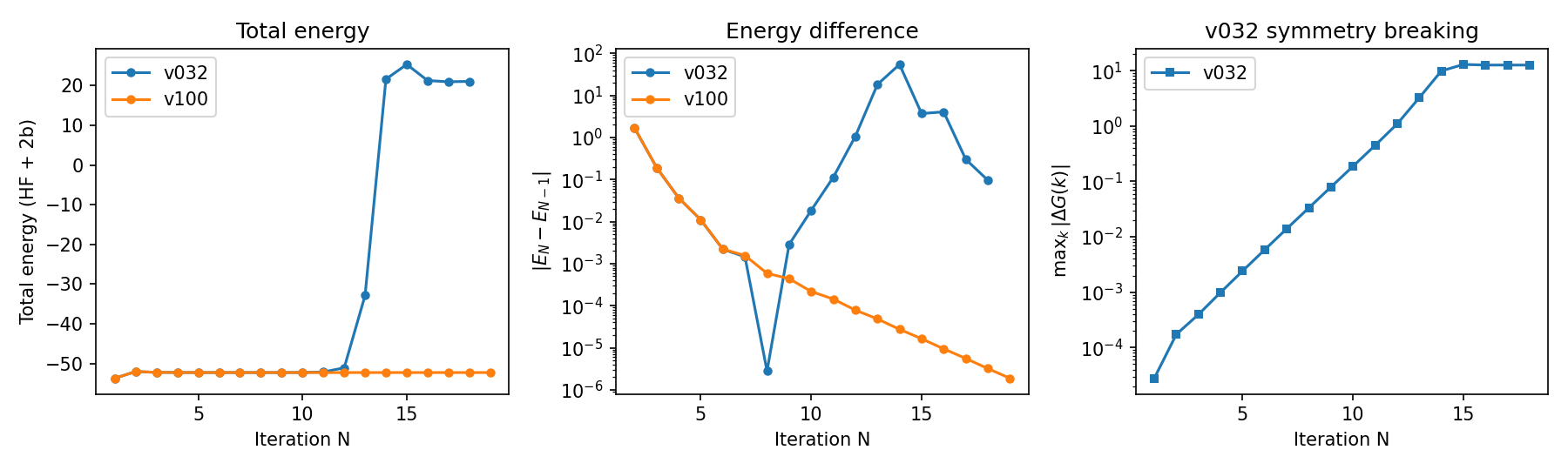
The public green-benchmarks suite validates the release across CPU and GPU calculations. Where the previous implementation was correct, 1.0.0 reproduces its total energies to the GW/SCF convergence threshold. It also resolves two important failure modes: the black-phosphorus symmetry contamination shown above and a broken CPU kernel for full-X2C germanium calculations. The corrected X2C CPU results now agree with the GPU path.
What is new in green-mbtools 1.0.0
- Symmetry-adapted input generation on independent k- and q-meshes, with space-group and time-reversal operators stored for downstream calculations.
- Full X2C and spin-orbit support, including double-group representations and correct treatment of time-reversal-invariant k-points.
- Reworked orthogonalization across MO, Löwdin, symmetric-Löwdin, and natural-orbital modes, with the exact AO-to-orthogonal transformation saved in
input.h5. - A clearer package structure: 🌿
mintfor mean-field input generation and 🥣pestofor analysis, continuation, transforms, and interpolation. - New IR, DLR, and uniform-grid conversion examples, optimized tensor contractions, and support for Python 3.13 and 3.14.
The legacy mbanalysis import remains available for now but is deprecated and will be removed in v1.1.
What is new in green-mbpt 1.0.0
- Space-group and double-group symmetry adaptation throughout the HF, GW, and GF2 kernels.
- A rewritten SEET preprocessing path with symmetry-consistent orthogonalization and basis-invariance regression coverage.
- Correct full-X2C CPU calculations, alongside MPI and self-energy correctness fixes.
- More robust impurity-solver and convergence behavior, including fixes for chemical-potential double counting and per-iteration timing statistics.
- Reproducible release provenance: every executable now reports its GREEN release through
--version.
Get GREEN 1.0
Install the Python tools from PyPI:
pip install green-mbtools==1.0.0The 1.0 input format has changed since 0.3.0. Please regenerate existing input.h5 files after upgrading so they contain the new symmetry and orthogonalization data.
- Install
green-mbtools1.0.0 from PyPI - Read the
green-mbtools1.0.0 release notes - Read the
green-mbpt1.0.0 release notes - Explore the validation results and benchmarks
GREEN 1.0 is the foundation for larger, denser, and more demanding simulations—without giving up the symmetries that make those calculations tractable.